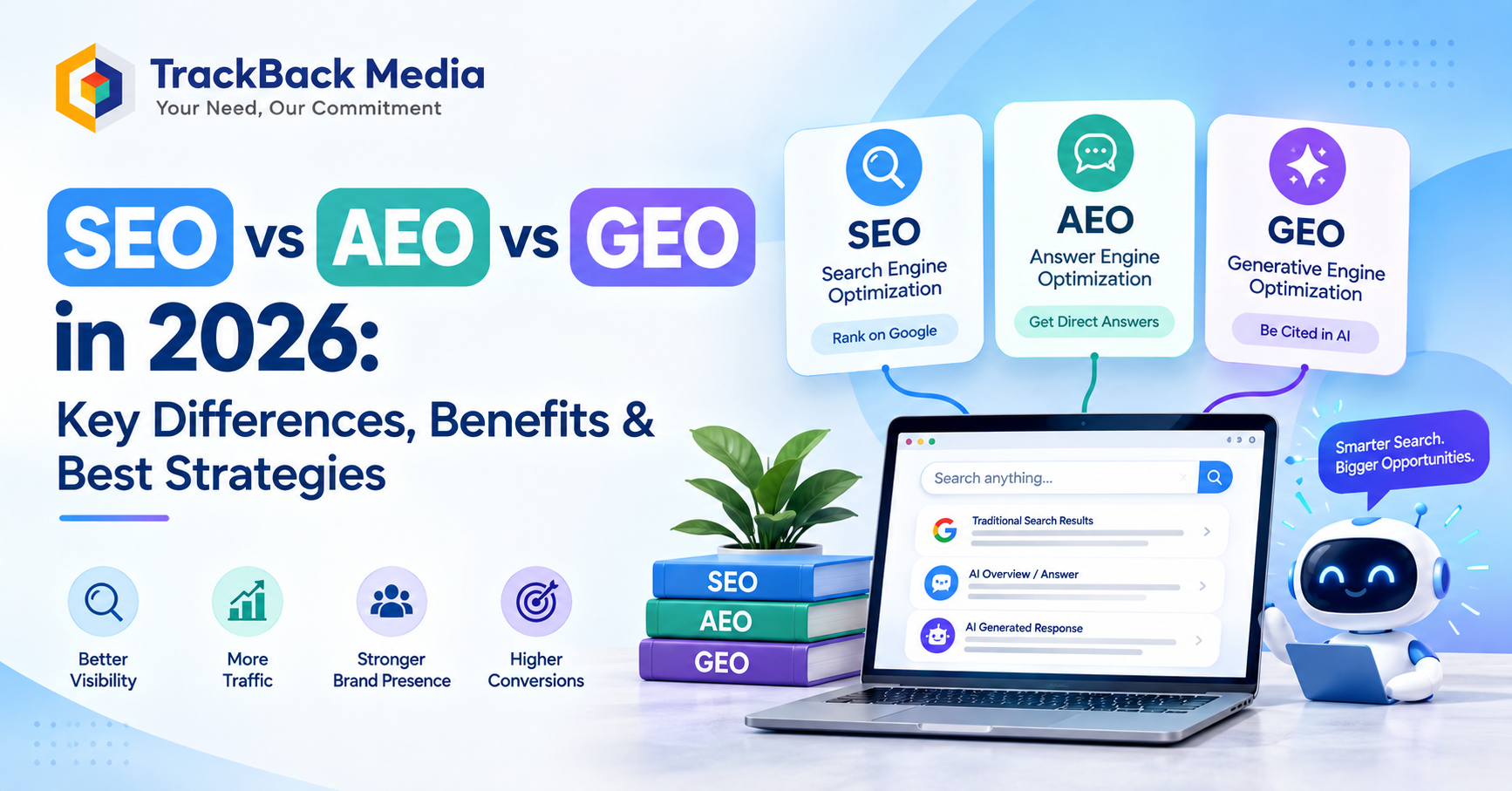
Search behaviour is evolving rapidly in 2026. Users no longer rely only on traditional Google search results to find information, compare products, and make purchasing decisions. They also ask questions through AI-powered search experiences, voice assistants, and conversational tools. As a result, businesses need to understand three important digital marketing strategies: SEO, AEO, and GEO.
But what is the difference between SEO, AEO, and GEO? Which strategy is best for your business, and how can you use them together to improve online visibility, website traffic, and lead generation?
In this guide, we explain SEO vs AEO vs GEO, their key differences, benefits, and best practices to help businesses prepare for the changing search landscape.
What Is SEO, AEO, and GEO?
SEO, AEO, and GEO focus on improving the discoverability of online content, but each has a different emphasis.
1. What Is Search Engine Optimization (SEO)?
Search Engine Optimization (SEO) is the process of optimizing a website to improve its visibility in organic search engine results, including Google and Bing.
Key SEO services include:
- Keyword research: Identifying relevant short-tail and long-tail keywords.
- On-page SEO: Optimizing title tags, meta descriptions, headings, URLs, and content.
- Technical SEO: Improving website crawlability, indexing, mobile usability, and page performance.
- Content optimization: Creating useful, relevant, and original content.
- Off-page SEO: Earning quality backlinks and building website authority.
- Internal linking: Connecting related pages to improve navigation and content discovery.
For example, a digital marketing agency targeting the keyword "SEO services" can create a dedicated service page, optimize its content, and build relevant backlinks to improve its organic search visibility.
Benefits of SEO
- Increases organic website traffic.
- Improves search engine visibility.
- Builds brand credibility and trust.
- Attracts users with relevant search intent.
- Supports long-term lead generation and business growth.
2. What Is Answer Engine Optimization (AEO)?
Answer Engine Optimization (AEO) is the practice of structuring and optimizing content so that answer-oriented search experiences can identify and present useful answers to users' questions.
For example, someone searching "What is technical SEO?" may prefer a short, straightforward definition rather than reading an entire article before finding the answer.
To improve AEO performance, businesses should:
- Answer common questions directly.
- Use descriptive headings and question-based subheadings.
- Include relevant FAQs.
- Provide concise definitions before detailed explanations.
- Use structured data where eligible and appropriate.
- Keep information accurate, clear, and easy to understand.
Benefits of AEO
- Helps content address specific search questions.
- Improves opportunities for featured snippets and answer-focused visibility.
- Supports conversational and voice-based search experiences.
- Makes information easier for users and search systems to understand.
- Can strengthen brand awareness across search touchpoints.
However, following AEO best practices does not guarantee featured snippets or inclusion in AI-generated answers.
3. What Is Generative Engine Optimization (GEO)?
Generative Engine Optimization (GEO) focuses on improving the likelihood that a brand or its content will be discovered, understood, cited, or mentioned in generative AI search experiences.
These experiences may include Google's AI-powered search features and conversational AI tools such as ChatGPT, depending on their search and browsing capabilities.
For example, a user might ask an AI search tool, "Which digital marketing agency can help a small business improve local visibility?" The response may include recommendations or references to relevant businesses and websites.
Important GEO practices include:
- Publishing original research, expert insights, and useful examples.
- Demonstrating relevant experience and subject-matter expertise.
- Maintaining consistent business information across trusted sources.
- Building brand mentions and earning credible backlinks.
- Organizing content with descriptive headings and clear explanations.
- Keeping website content accurate, updated, and accessible to search systems.
- Supporting important claims with reliable sources and evidence.
Benefits of GEO
- Creates opportunities for visibility in AI-generated responses.
- Helps strengthen brand recognition across AI search experiences.
- Supports discovery during complex research and comparison queries.
- Encourages the creation of credible, well-structured content.
- Can complement existing SEO and content marketing efforts.
GEO does not guarantee AI citations or recommendations. Results depend on the platform, query, available sources, and other factors.
SEO vs AEO vs GEO: Key Differences
Although SEO, AEO, and GEO overlap, their primary goals and optimization approaches differ.
| Factor | SEO | AEO | GEO |
| Full Form | Search Engine Optimization | Answer Engine Optimization | Generative Engine Optimization |
| Focus | Search rankings | Direct answers | AI search visibility |
| Content | Relevant, detailed | Clear, concise | Credible, informative |
| Opportunities | Organic results | Featured snippets | AI mentions and citations |
| Key Activities | Keywords, links, technical SEO | FAQs, direct answers | Authority, original insights |
| Goal | Organic traffic | Answer visibility | AI brand visibility |
The key takeaway is that SEO helps users discover web pages, AEO emphasizes answering their questions, and GEO focuses on visibility in generative AI experiences. These are overlapping approaches rather than completely separate disciplines.
Which Strategy Is Best for Your Business in 2026?
The right approach depends on your business goals, audience, and existing digital marketing performance.
Choose SEO when:
- You want to improve Google rankings and organic traffic.
- Your business depends on website visits and service-page discovery.
- You need a strong technical and content foundation.
Prioritize AEO when:
- Your audience frequently searches specific questions.
- You publish educational blogs, guides, tutorials, or FAQs.
- You want to make answers easier to extract and understand.
Invest in GEO when:
- Your customers use AI-powered tools to research products or services.
- You want to increase brand visibility in generative search experiences.
- You can publish credible information that helps answer complex questions.
For most businesses, the strongest strategy is to combine all three rather than choosing only one.
Conclusion
SEO, AEO, and GEO are important components of a modern digital marketing strategy in 2026. SEO supports organic search rankings, AEO makes content more useful for question-based searches, and GEO helps businesses pursue visibility in generative AI experiences.
Instead of treating them as competing strategies, businesses should build a unified approach based on helpful content, technical accessibility, clear answers, and genuine authority.
Start with strong SEO fundamentals, structure content to answer real customer questions, and strengthen your brand's credibility for AI-driven discovery. This integrated approach can help your business build sustainable online visibility as search behaviour continues to evolve.